You could reserve ten nights in one Umbrian town without us
You could reserve ten nights in one Umbrian town yourself: two emails, one card, an afternoon of comparing floor plans. We have put the week in the catalog anyway, because ten nights in a single bed is a shape people ask for and rarely hold to, and because the difference between an easy stay here and a tiring one is about sixty steps.
- Starting figure, per person
$2,280
- Nights
- 10
- beds you will learn
- 1
- Country
- Italy
- How much of this you could arrange without us
- you could arrange all of this yourself
Confirmed as a final figure once the supplier holds the dates. Getting to the country is not included.
- Whatever is agreed comes back to you in writing from the supplier, before any money moves.
- No card is asked for on this site and none is stored: the supplier takes payment on its own terms.
- A request sent through the form is answered in writing within one working day.
Two emails and a bank transfer, and none of it needs us
That is the honest answer for this week and it belongs at the front, before the photographs do any work. All of it. The apartments and small hotels inside the walls answer email in English, usually inside a day; the deposit goes by bank transfer and the balance on a card at the door. Your own flight lands at Rome or at the small field near Perugia, and from either one there is a train up the valley with a single change. Nothing on this page needs an introduction, a phone call in Italian, or somebody who knows a name.
So what is left for us. Three things, and not one of them is necessary. Listings almost never mention that a bed sits sixty steps above the nearest point a car can reach, and in a town built on a gradient that one detail decides your ten nights; we keep notes on which is which. We can put a single request to four owners at once and hold two answers open for a week while you argue about it at home, which is awkward to do politely on your own. And we will say, before anything is reserved, if your dates land on the two days when the whole valley wants a bed here.
The town, and the shape of the ground
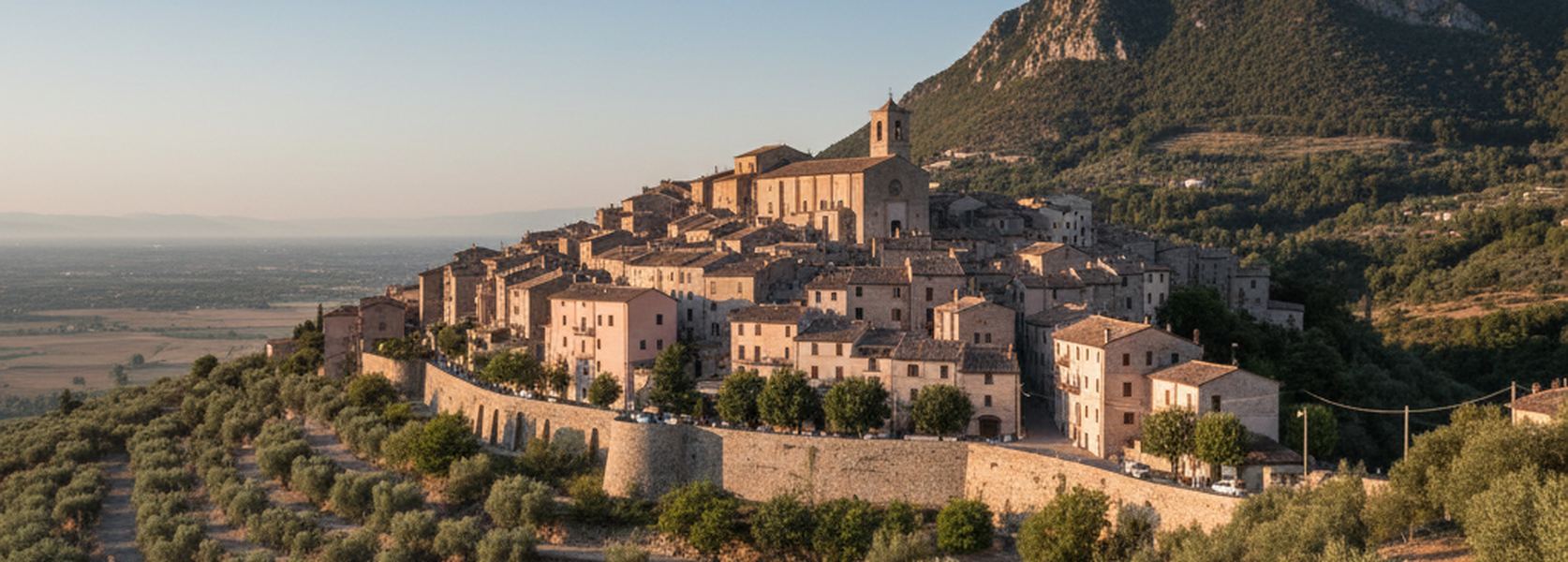
Spello stands on the southwest flank of Monte Subasio in the province of Perugia, about 280 meters up, with roughly 8,600 people, most of whom live below the walls in the newer streets near the station. The old town is one long climb. From the Roman gate at the bottom to the belvedere at the far end the lanes rise about eighty meters over a kilometer, stepped in places, paved in the pink and gray limestone quarried out of the mountain behind. In low sun the whole hillside turns rose colored, and that is the stone rather than a trick of the season.
Two of the gates are Roman, one of them flanked by twelve sided towers. The parish church holds a chapel frescoed by Pinturicchio in 1500 and 1501 and a majolica floor laid in 1566, and on a Tuesday in October you can stand in front of it alone. Ten minutes below the walls a Roman villa sits under a modern roof with its mosaic floors intact.
There is no lift anywhere in the old town and no step free route into it. A wheeled case is a mistake here; carry your bag, or pay someone at the station to drive it up for you.
What the ten nights actually consist of
Very little happens, and that is the design. Shops open around half past eight, shut somewhere between one and four, then run until half past seven. The churches keep roughly the same hours, so the middle of the day is for eating, sleeping, or sitting on a wall watching the plain. There are two bakeries, half a dozen bars and eight or nine places to eat, of which three or four take a day off each week; in January and February some close for a fortnight and do not announce it anywhere. One morning a week the market fills the lower piazza and is packed away by half past one.
By the fourth day you will have walked every lane in the town twice. That is either the point of the week or the flaw in it, and it is worth deciding which before you commit.
Days out are easy without a car. The station is 1.2 kilometers below the gate and seventy meters down, fifteen minutes going and twenty five coming back, and the regional train reaches Assisi in about eight minutes, Foligno in five, Perugia in half an hour, roughly hourly and thinner on Sundays. From the far gate a track climbs into the holm oak and out onto the open grass of Subasio; the summit is 1,290 meters, a thousand meters of ascent, four hours up on a cool morning.
Months, weather, and what is shut
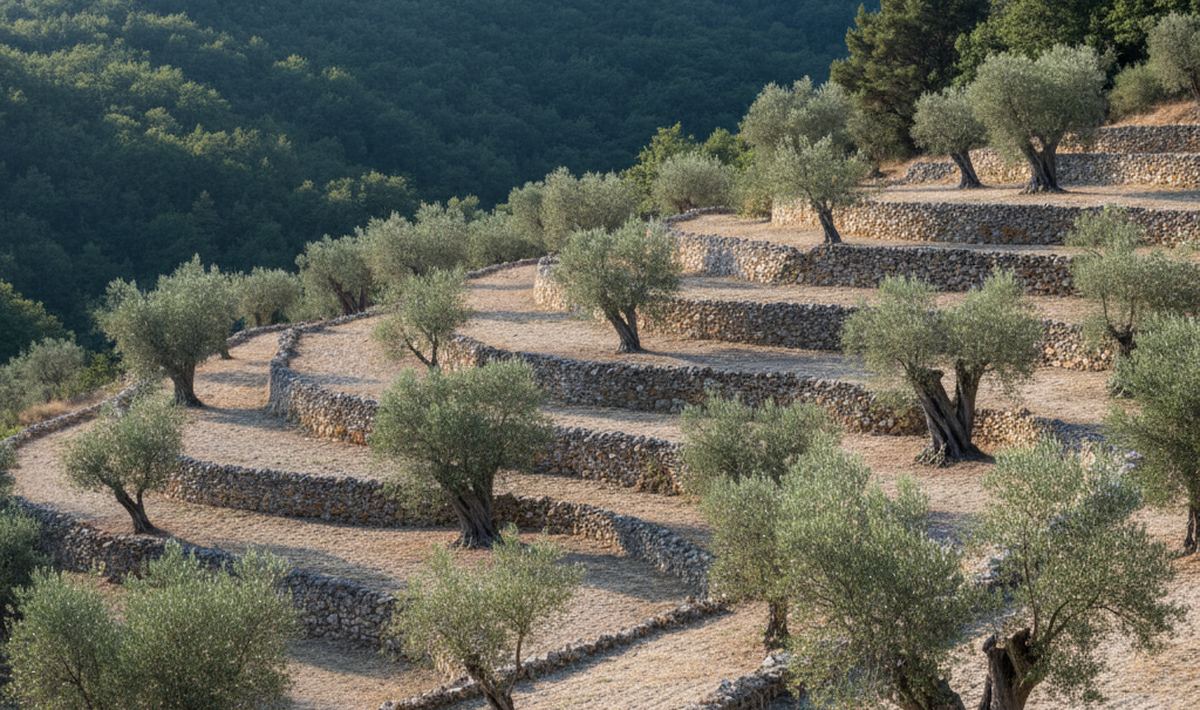
July and August afternoons run 31 to 34 degrees and the stone holds the heat until midnight; the lanes are in shade only at either end of the day. September starts near 27 and finishes about 20, with nights around 13, and it is the month most people are picturing when they ask about this. October falls to 19 or 20 and brings the first real rain; from about the twentieth the olive mills run day and night and the whole valley smells of crushed fruit and smoke. November sits at 12 to 14, with fog lying on the plain below while the town stands in sun above it, which some people find worth the journey and others find grim.
Ask what the heating is before you agree to anything in November. Many apartments in these stone houses have one heat pump and a tiled floor, and that is a cold pairing at ten degrees.
There is one date to plan around. On Corpus Domini, nine weeks after Easter, so late May or June depending on the year, the town lays flower carpets the length of its lanes overnight and beds for twenty kilometers in every direction are gone months ahead. If that is what you came for, say so early. If it is not, take the fortnight on either side of it.
The gradient settles this one before we do
It suits two adults who can manage steps and steep paving all day, who will cook two nights in three, who read in the afternoon and would rather go back to the same bar than hunt for a new one. It suits walkers. It suits anyone who has done the four towns in eight nights version of Italy and does not want to pack again.
It does not suit anyone who cannot climb. There is no route into the old town that avoids the gradient, and we will decline rather than sell you a bed you cannot reach. It does not suit a family with a pram. It does not suit anyone who wants the sea, a different view every second morning, or something to do after ten at night.
From $2,280 per person covers ten nights inside the walls, in a one bedroom apartment or a room in a small hotel, out of high season, with the cleaning charge and the nightly per person town tax included. It does not cover your flights, your food, or a car; ten days of a small hire car runs somewhere between $400 and $600 by month. The walls are closed to traffic by camera, and the fine reaches your home address about four months later through the hire desk. The final figure is set by the owner of the bed, not by us.
Short answers to the usual doubts
Is getting there something you handle?
No. This office arranges no carriage by air or by sea, holds a contract with no carrier, and has no intention of acquiring one. Your flights are yours: you choose them, you buy them, and you own the problem when they move. What we will do is read your arrival times back to you before you commit, because the last useful connection up the valley goes in the early evening. Miss it and you are in a taxi from Perugia, about forty minutes and near ninety euros. Better to know that before the ticket is bought.
Ten nights in one small town. Will we run out of it?
If running out means seeing everything, yes, and about four days will do it. The week runs on repetition instead: the same baker, the same corner table, the walk up Subasio done twice in different weather, afternoons that go nowhere at all. Some people find that is the entire reason to take ten nights in one bed. Others are restless by the sixth day and start hiring a car to get out. If you suspect you are the second kind, split the fortnight between two places, and we would rather say that now than after you have paid.
What do you charge us for arranging it?
Nothing, and no money passes through this office at any point. You settle with whoever owns the bed, on their paperwork, by whatever method they use, and we never see or hold a card number. Some weeks after you are home they send us a percentage of what they kept. It is worth naming what that arrangement does to us: we are paid the same whether we were useful or merely decorative, so the only decent way to run it is to tell you, as we have on this page, when a week is one you should arrange on your own.
Do we need a car?
Not for most of the ten nights. The train handles Assisi, Foligno and Perugia from a station fifteen minutes downhill, and the town itself asks for nothing but shoes. You need a car for the wine hills to the south, for Bevagna and Montefalco, for the mills during the olive harvest, and for the mountain road if you would rather not walk up it. Most people take one for three or four days in the middle and leave it outside the walls, where spaces are metered by day and free overnight. Driving in through the gates is restricted, and the cameras do not miss.