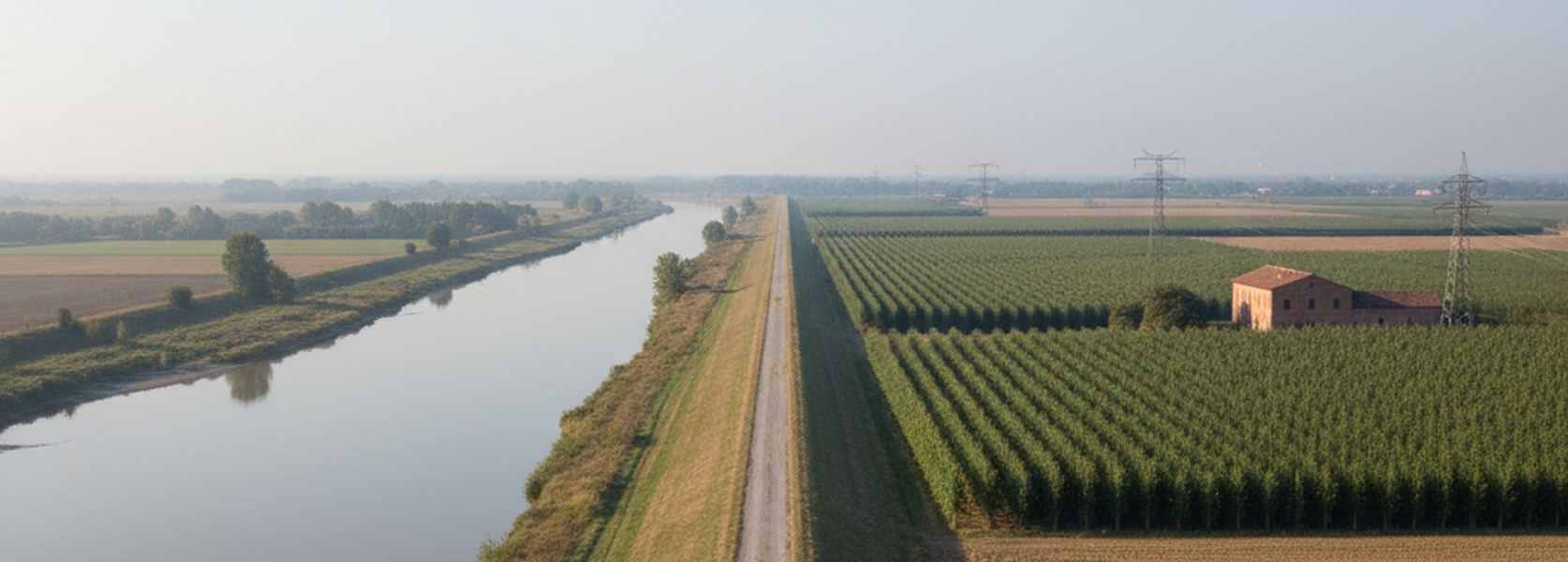
The only climb is getting up onto the levee, so reserve a walking week on the Po plain
You could arrange most of this yourself, and we would rather say that first. The trains run, the two hotels answer email, and flat ground needs no guide. If you still want to reserve a walking week on the Po plain, this page is about the handful of things that go wrong without a telephone.
- Starting figure, per person
$2,200
- Nights
- 9
- beds you will learn
- 2
- Country
- Italy
- How much of this you could arrange without us
- you could arrange most of it yourself
Confirmed as a final figure once the supplier holds the dates. Getting to the country is not included.
- Whatever is agreed comes back to you in writing from the supplier, before any money moves.
- No card is asked for on this site and none is stored: the supplier takes payment on its own terms.
- A request sent through the form is answered in writing within one working day.
You could arrange most of this yourself
Here is the number the whole catalog is sorted on, and it does not flatter us. You could arrange most of this yourself. Both cities sit on regional lines. The two hotels answer email in English inside a day. The ground is flat, marked in places, and hard to get lost on for long. An adult with one free afternoon, a map and some tolerance for reservation forms would end up with a week that looks much like ours.
What is left is the residue, and the residue is what this office is for. It is finding a driver in a village of nine hundred people who will collect two tired walkers from a levee crossing at half past four on a Sunday. It is getting one hotel to hold a room while another holds a bag. It is asking, in the third week of April, whether the track along the north bank has been mown yet, because after a wet spring it stands waist high and the answer decides the day. If that residue sounds like an afternoon you would enjoy, take it. We would rather lose the reservation than pretend the week is difficult to build.
Ten days on ground that does not rise
Mantua sits 19 meters above the sea. Ferrara sits 9. Between them the Po runs inside earth levees 5 to 8 meters high, and the levees are where you walk: a mown crown two or three meters wide, gravel or grass, river on one side, maize, wheat and poplar plantation on the other. The climb in a full day is the cost of getting up onto the bank in the morning and down off it at dusk. Call it 15 meters.
Of the ten days, seven are walking days, one is the move between cities, and the first and last belong to your own travel. Walking days run from 9 to 22 km, and four of them sit above 18. That is three to six hours at a pace with stops in it. Surfaces are gravel, farm asphalt and cut grass. Two stretches share the long cycle route that follows the north bank, so you will step aside for bicycles. Shade is thin; a poplar plantation gives you twenty minutes and then hands you back to the sun. Between villages there is nothing at all. No bench, no tap, no roof.
Two beds, nine nights, one car
Five nights in Mantua, four in Ferrara, and on the morning of day six a car journey of about 90 km that carries both of you and everything you brought. Nothing else moves. You walk out from the bed you woke in and come back to it, so the packing happens twice in nine nights instead of eight times. That is the point of the shape, and it is why this week sits in the shortlist it sits in.
From Mantua the days go north along the Mincio, through the flat oak and hornbeam wood at Marmirolo, 233 hectares without a contour in it, and south to the lock at Governolo where the Mincio gives itself to the Po, 18 km out. From Ferrara they go east into the drained land along the Po di Volano, and once around the 9 km circuit of brick walls that rings the city, which is a rest day dressed as ten thousand steps. Returns are by regional train where there is a line, by a bus that runs four times a day where there is not, and on two days by a car reserved before you left home.
Water, mosquitoes, and the two windows that work
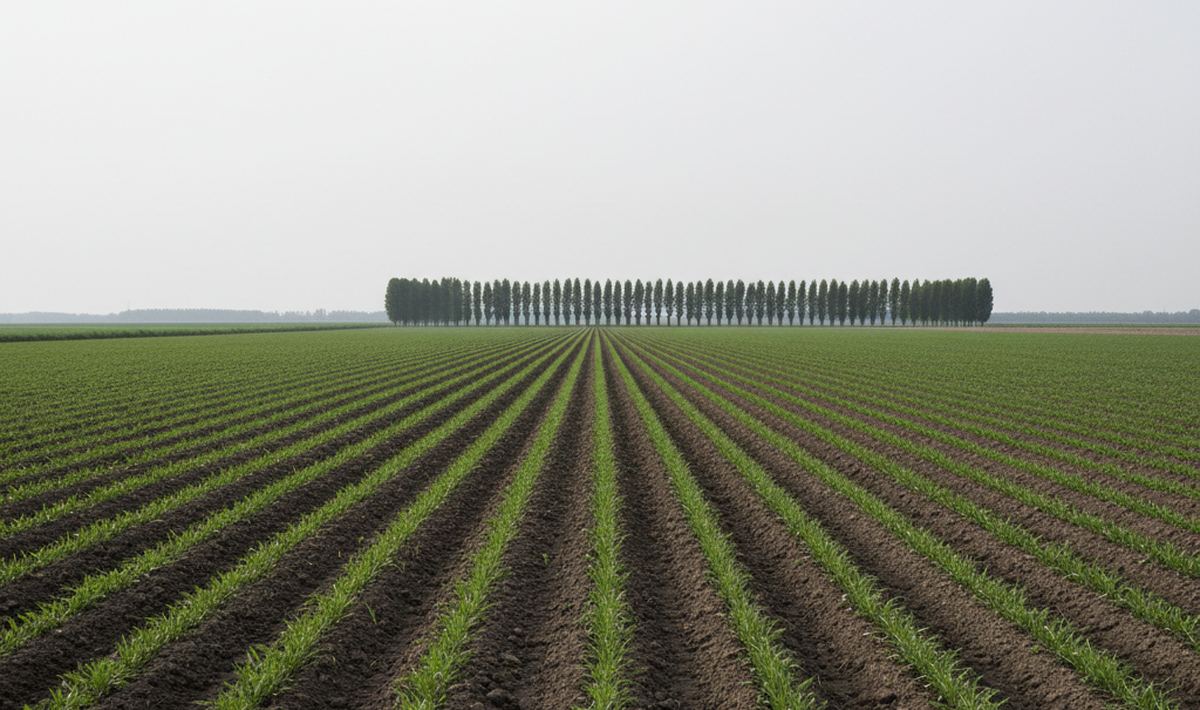
The plain was marsh, then it was drained, and it has never fully agreed to the arrangement. East of Ferrara the fields lie under the level of the sea; the ground out near Jolanda di Savoia sits about 3.4 meters below it and stays dry because pumps run. You walk beside the canals that do that work, straight lines of water carried at shoulder height while the beet sits at your ankle.
Two windows work. Late April to the middle of May, and the middle of September to the middle of October: afternoons between 18 and 26 degrees, long light, and farm traffic rather than visitors. July and August bring 31 degree afternoons, humidity that does not lift after dark, and the striped daytime mosquito that has been resident here since the nineteen nineties. From November into February the fog settles for days at a time, and a levee in December is a white corridor with a river somewhere in it. Rain runs to about 700 mm a year, most of it in spring, which is also why the grass on the bank grows faster than anyone can cut it.
The bill, and the two adults it was written for
From $2,200 per person for nine nights. It covers the two rooms with breakfast, the car and the luggage between cities on day six, day sheets that mark the village bars, the water taps, the two points where each day can be cut short and the platform you come home from, and a driver held on the two days above 20 km. It does not cover lunches, dinners, train tickets or your flights, which are yours to reserve and not ours to arrange. Nothing is paid to this office and no card details reach it; the two hotels pay us a percentage once you have checked out, and that is the whole of our income on this week. We arrange no insurance and no travel documents and will not advise on either.
It suits two adults who walk four to six hours without fuss, who want no climbing at all, and who are content with a village of two thousand people and a kitchen that opens at half past seven. It does not suit anyone hoping for a hill, anyone who wants a swim at the end of the day, or anyone whose only free month is July.
Short answers to the usual doubts
Can you reserve our flights?
No. Aeroplanes and ships are not something this office puts anybody on, and nobody who runs one has an agreement with us. Reserve your own seats, in your own names, with whoever you like, and tell us what time you expect to be in Mantua. Cover of any kind, and anything to do with crossing a border, goes back to you as well; those questions belong to people who are answerable for their answers. What we can do is hold the first room against a late arrival and tell the hotel not to give it away at six o'clock.
How often do the bags move?
Once. On the morning of day six a car takes both of you and everything you brought about 90 km east to the second bed, and after that the luggage does not move for four nights. On walking days you carry a small pack: water, whatever you bought for lunch that morning, a hat, and sleeves for the wind that comes off the water after four o'clock. Nothing is carried for you along the walk itself, because every day finishes at a station, a bus stop or a village square.
Is the week walkable in July?
Walkable, yes. Sensible, we think not, and we would rather say so before you reserve than after. Afternoons reach 31 degrees with humidity that stays put after sunset, the levee crown runs 5 km at a stretch without shade, and the daytime mosquito is at its height from July into September. If July is the only month you have free, tell us, and we will say plainly that those are the wrong dates for this week instead of selling you nine nights of it.
What happens if one of us cannot finish a day?
Each day sheet names two points where the walk can be cut, both within 3 km of a village with either a station on the regional line or a bus running four times a day. Both carry the number of a driver who has agreed in advance to answer between eight in the morning and eight at night, and neither bed is more than an hour away by road. Nobody is expected to walk to the end of a line drawn by an office in Kansas City.