You could reserve ten nights in a lower Normandy market town yourself, and mostly you should.
Most of this you could arrange without the office. You could reserve ten nights in a lower Normandy market town on your own screen in an evening, and land near our figure. What is left is a house owner who answers a landline and not an inbox, and two mornings that exist only after a telephone call.
- Starting figure, per person
$2,320
- Nights
- 10
- beds you will learn
- 1
- Country
- France
- How much of this you could arrange without us
- you could arrange most of it yourself
Confirmed as a final figure once the supplier holds the dates. Getting to the country is not included.
- Whatever is agreed comes back to you in writing from the supplier, before any money moves.
- No card is asked for on this site and none is stored: the supplier takes payment on its own terms.
- A request sent through the form is answered in writing within one working day.
What ten nights here actually consist of
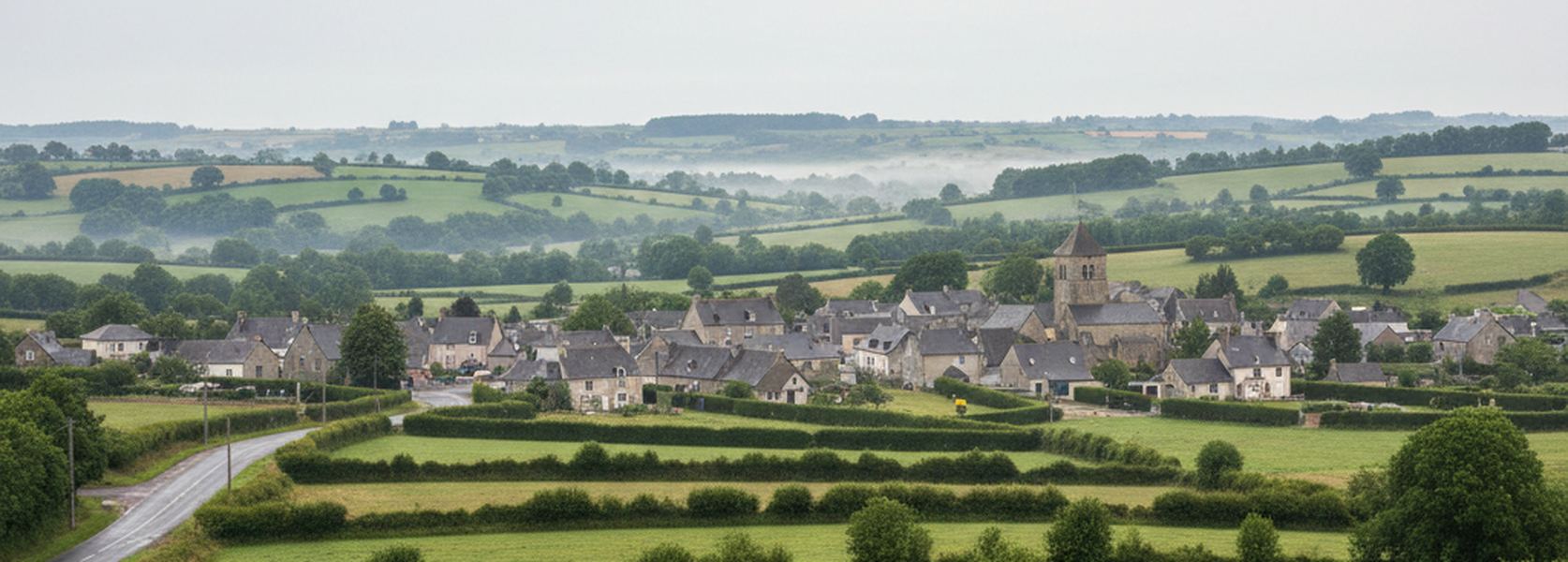
One bed, ten nights, one rented stone house at the edge of a market town of about 3,000 people. The square is 600 m from the door, four or five minutes on foot with a basket. The bakery opens at 07:00, shuts at 13:00, opens again at 16:00, closes at 19:30, and stays dark all Monday. The market fills the square one weekday morning, roughly 08:00 to 12:30; by 13:15 somebody is hosing the stones down. Beyond that the town holds two bars with outside tables, a butcher, a grocer, a pharmacy that shuts for two hours at midday, and a mid size food shop 1.4 km out on the main road that runs to 19:30. That is the whole inventory, and it does not grow while you are there. A day is a walk of 9 to 14 km on lanes, an hour back at the house doing nothing in particular, and an evening that starts late because in the last week of June the light holds past 21:45. Three of the ten days want the car: the coast at 45 km, the tidal bay at 60 km, the river gorge at 38 km. The other seven happen within an hour of the front door, on foot.
Underfoot across the ten nights
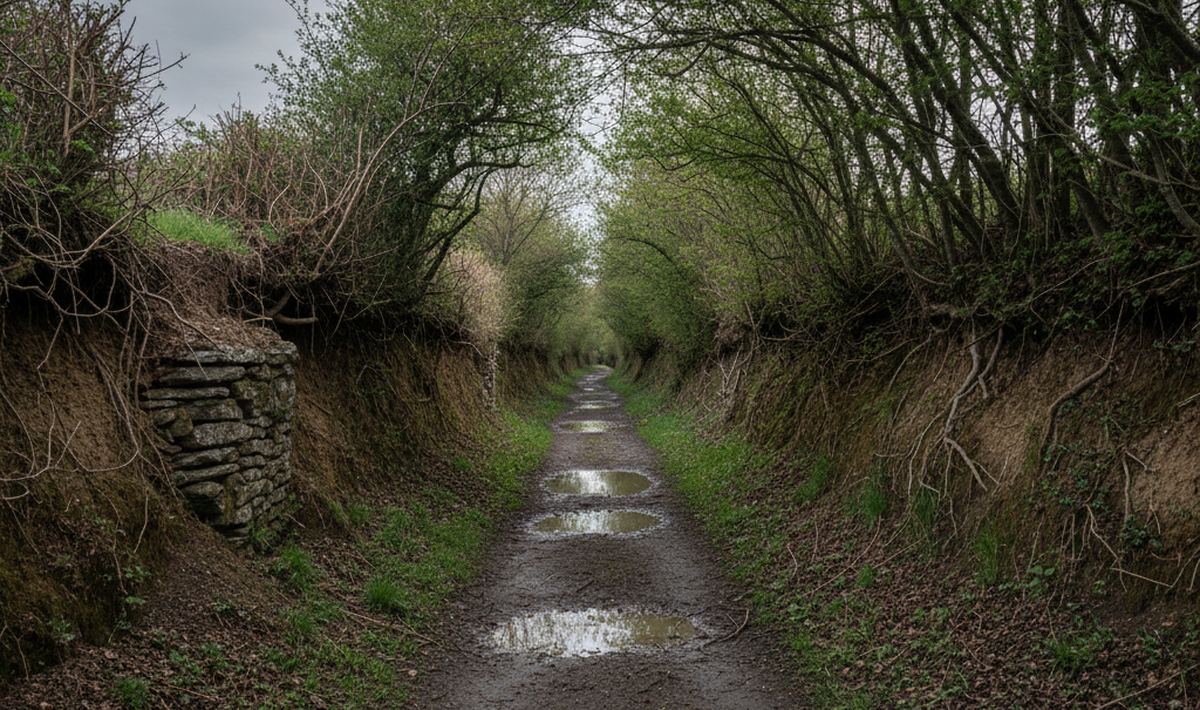
The lanes are sunk. Cart wheels and rain have cut them a meter or more below the fields, and the banks on either side are earth held together by roots, with hazel and thorn along the crest closing over your head. A lane runs about three meters wide, offers no verge to step onto, and drains badly; after rain the middle is grit and the edges are clay that comes home with you. Gradients hold 8 to 12 percent for stretches of 300 to 600 m, because the rock is granite and the streams have cut it into short steep valleys. Nothing in this country stands higher than about 360 m, which reads like nothing and is not: a 12 km day will take 400 to 600 m of climbing and you will walk it at 3.5 km an hour rather than 5. Waymarking exists and is not continuous. Carry the 1:25,000 sheet, buy it in the grocer on the first morning, and expect the mobile signal to fall away in the valley bottoms. By late August brambles have taken back a third of the width on the quieter lanes. Boots rather than trainers, and a second pair to change into at the door.
Rain, and the arithmetic of ten nights
Inland lower Normandy takes roughly 850 to 950 mm of rain a year, spread over about 170 days, which sounds heavier than it feels; most of those days deliver under 3 mm and have finished by 11:00. Between June and September, plan on four or five of your ten days carrying rain, and one day on which it simply does not stop. Daytime highs sit near 21 C in June and September and near 23 C in July and August. Nights fall to 11 or 13 C, and a house with 60 cm stone walls holds its cool for a week after warm weather, which is welcome in August and dour in late May. The wind arrives off the Channel from the west and pushes cloud through in bands, so a gray sky at 09:00 tells you very little about 15:00. Nobody can promise you weather and this office will not attempt it. What we do instead is keep the two arranged mornings movable inside the ten nights, so a wet Tuesday costs you a lie in and not the thing you came for.
How much of this you could arrange without us
The honest answer for this week is that you could arrange most of it yourself, and we would rather print that than dress it up. The house is listed on two rental sites. The car is twenty minutes of typing. The market needs arranging by nobody; it happens whether you come or not. The walking lives on a paper map that costs about 13 EUR in the grocer. What is left is three telephone calls. The owner quotes a ten night rate by telephone only, in French only, and settles by bank transfer rather than card. A working orchard that presses in October will walk you round the press for an hour, publishes nothing anywhere, and answers a landline between 12:00 and 14:00. A dining room in the next town holds tables by voice only and will not hold one for a name it has not spoken to. If those three things are not what you came for, reserve the week yourself. We will not mind, and we would rather you kept the money in your own pocket.
Inside $2,320, outside it, and the people who should stay home
From $2,320 per person, for ten nights: the house, linen, the end clean, a small manual car for eight of the ten days, and the two things reserved by telephone, being the orchard morning and the table in the next town. Not in it: your own flights, fuel, road tolls of about 30 EUR each way from the nearest large airport, food, and whatever you add once you are there. The figure moves with the season and with the exchange rate, and the final one goes to you in writing before anything is held. No money passes through this office and we hold no card details. Each firm bills you on its own paper, and our fee is settled by them once you are home. Etre Super Travel is an independent agency; it owns no houses, operates no aircraft, runs no tours, and belongs to no group that does. This suits people who want one bed, a paper map, and a town they can walk into at 08:00 for bread. It does not suit anyone wanting a different view every second night, anyone who cannot manage a wet 12 percent slope, anyone who needs an automatic car without asking months ahead, or anyone for whom rain on four days out of ten would spoil the point of being there.
Short answers to the usual doubts
Do you reserve our flights?
No, and there is no version of this office that could. Nothing with wings and nothing with a hull is sold from this desk, and we sign nothing with the firms that operate them. Your flights are yours to choose, buy and hold, with your names on them rather than ours. Tell us the arrival hour before we reserve the house, though, because keys change hands between 16:00 and 19:00 and the owner lives 9 km away; a landing that puts you at the door at 22:00 turns into a first night spent somewhere else entirely.
Do you handle passports, visas or travel insurance?
No, on all three, and we will not advise on them either. That is not modesty. We are not qualified, the rules move without telling anybody, and a wrong answer from us would cost you the trip rather than cost us anything. Ask people who do that work for a living, and ask them before you reserve the ten nights rather than after, because the house rate is settled by bank transfer and the dates are firm once it clears.
Can the ten nights be done without a car?
Partly. On foot you keep the town, the market morning, and a dozen walks that start at the front door, which is a real holiday for some people. Without a car you lose the coast at 45 km, the tidal bay at 60 km and the gorge at 38 km: the bus runs twice on a weekday, not at all on Sunday, and the nearest station sits 22 km off. Two households have taken this week car free because they wanted only lanes. Say so early and the car comes out of the figure.
If we could arrange most of it ourselves, why bring you in at all?
For three telephone calls made in the right language at the right hour of the day, and for somebody to shift the arranged mornings when a Tuesday turns wet. That is the whole of it on this week, and we are not going to inflate it. You pay this office nothing directly; our fee is settled by the firms after you travel. So the only question is whether those calls are worth the ten minutes it takes to hand us your dates. Plenty of readers decide they are not, and reserve it themselves.