The estate fixed its dates in June, so ask early if you want us to reserve a harvest week in the Douro Valley
The picking starts at seven and the dates were fixed in June, so nobody is moving them for you. As far as beds, trains and dinner go, you could reserve a harvest week in the Douro Valley without us in an afternoon. The hard half, a place on a working estate's line while it is picking, needs a telephone call.
- Starting figure, per person
$2,980
- Nights
- 9
- beds you will learn
- 2
- Country
- Portugal
- How much of this you could arrange without us
- the hard half needs a telephone call
Confirmed as a final figure once the supplier holds the dates. Getting to the country is not included.
- Whatever is agreed comes back to you in writing from the supplier, before any money moves.
- No card is asked for on this site and none is stored: the supplier takes payment on its own terms.
- A request sent through the form is answered in writing within one working day.
Nine nights, two beds, and where they sit
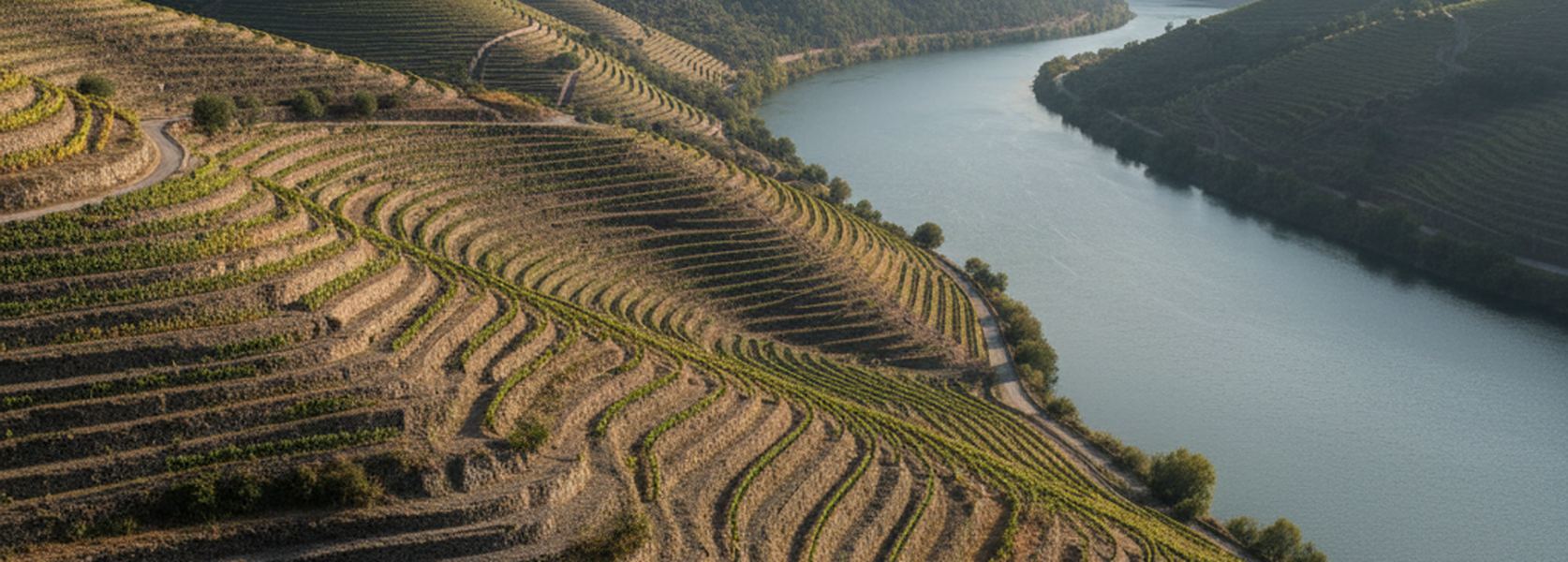
Bed one is a family estate in the Cima Corgo, about eight kilometers above Pinhão on the road that climbs to Provesende, at roughly 400 meters with the river a long way below it. Six nights there. Bed two is three nights upstream past Pocinho, where the valley opens out, the hills go bare and the picking is normally finished a week before it finishes downstream. Porto to Pinhão is about 120 kilometers and a little over two hours by road. The train takes around two and a quarter hours and spends its last 25 kilometers at the water, which suits anyone who would rather not meet the N222 after dark; it is 27 kilometers of switchbacks up from Régua and it is not a road to learn at night. Between the two beds it is 65 kilometers and roughly an hour and twenty minutes, and the office moves you and the luggage so that the day is not spent on it. Four of the six days at the first bed are picking days. The other two are yours, and most people spend one of them doing very little.
The easy half is an afternoon of typing
The honest answer for this week is the third of the four we use: the hard half needs a telephone call. The easy half really is easy. Rooms in Pinhão, a train out of Porto, a hire car, a table for eight o'clock, the road up to Favaios and back down again; an adult with a laptop can assemble all of that in an afternoon, and if what you want is the valley in September rather than the work in it, assemble it and keep your money. We say so on the telephone, and we would rather say it than take a reservation we did not earn. The half that does not work that way is the estate. In the last days of September nobody there is reading email. The office is a weighbridge and a whiteboard, and the manager is counting crates. Two guests on the line are two people who need showing where to cut, and whether he can absorb that is a question somebody has to put to him out loud, in June, in Portuguese, having put the same question to him the year before. That call is the thing we are actually for. It is neither clever nor quick, and without it you are watching the harvest over a wall.
Schist, heat, and what nine days ask of you
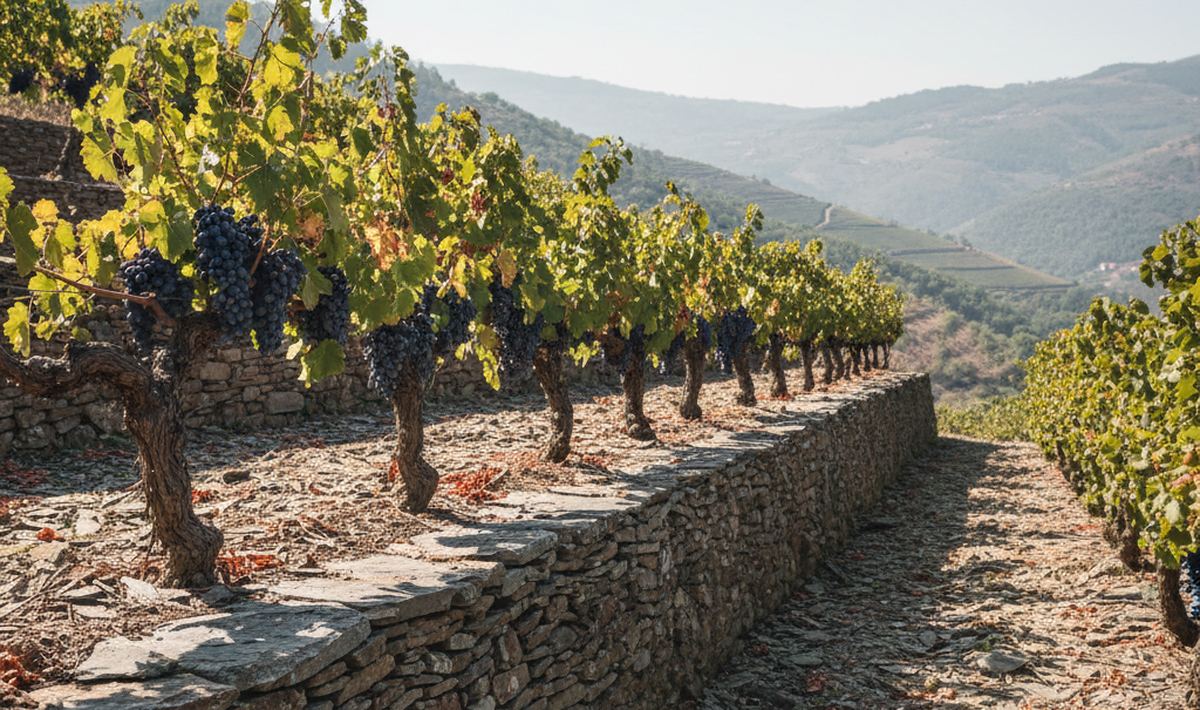
The vines stand on schist, a layered rock that breaks into flat gray plates and holds the day's heat like a storage heater. Slopes run to 60 per cent in places. Some rows sit on narrow walled terraces two vines wide, built by hand and older than the records; some sit on the wide earth ramps cut in the 1970s; some run straight up and down the hill. What they share is that no machine can pick them, which is the entire reason this work still exists. Picking starts at seven, before the sun clears the ridge. Bread and soup at about ten, and the line usually stops between one and two, by which time it can be 32 degrees on an unshaded terrace and the plates underfoot are too hot to sit on. You carry secateurs, cut into a small basket, tip into a crate, and somebody stronger carries the crate. Wasps come with ripe fruit. Hands get cut in the first hour and stop getting cut by the third day. Treading happens after dinner, in a granite tank about eighty centimetres deep: two hours, knee deep, in shorts, moving in a line at first and then however you like. It is colder than anyone expects, and it is optional.
What the price covers, and who takes your money
From $2,980 per person covers the nine nights, breakfast every morning, five dinners at the long table, the four days on the line, the evenings in the press house if you want them, and the move between the two beds. It does not cover lunches away from the estate, wine you decide to carry home, a hire car if you want one, or your own flights, which are yours to arrange and remain yours throughout. This office arranges no travel by air or by water and holds a contract with no carrier. The figures are the two houses' own for this season and they are confirmed in writing when the week is held, not before. Money never passes through here. You settle with the estate and with the house upstream, separately, on their own paper and to whatever schedule each of them sets; the estate normally wants a share in July and the rest on arrival. Weeks later, once you are home and the fruit is in the tank, each of them pays us a percentage for the introduction and the arranging. We hold no card details, which also means we cannot hold a week for you by taking a deposit.
Who lasts four mornings on the slope, and who does not
It suits people who are content to be handed a job and told they are doing it wrong, who can stand six hours on a slope in real heat, and who read a forecast as information rather than as a promise. It suits two people who still like each other's company at eight in the evening in a village of three hundred with one shop and no reason to stay up. It does not suit knees that object to uneven stone. There are no handrails on the terraces, the risers between them are 30 to 40 centimetres and irregular, and there is nowhere on that hillside for anything with wheels. It does not suit small children; the line is no place for a four-year-old and dinner starts at half past eight. It does not suit anyone who needs the dates to be negotiable, because they are not. If what you actually want is the valley itself, a car, three tastings and a long lunch above the river, that is a different week, it is simple to arrange, and you should arrange it yourself. Ask us for it and we will tell you the same thing twice.
Short answers to the usual doubts
Can the dates move if our own flights land at an awkward time?
No. The estate fixes its picking dates in June, when it reserves its teams and its lorries, and it will not reopen them in September for two guests. Arrive a day late and you lose a picking day and the night is charged anyway. If the fruit ripens early and the line starts before you do, you get the tail of the harvest and the pressing rather than the first cut. That is the trade for a fixed date inside the busy weeks, and we would rather you read it here than hear it from us in a bad week.
How much picking is actually expected of us?
Four mornings, seven until one, and nobody counts your crates. People stop when they stop; there is shade at the head of most rows and a chair in the sorting shed for anyone who has had enough of the slope. If the line is full on a given morning the estate puts guests at the sorting table instead, which is standing work in the cool and just as much part of the week. The granite tank in the evening is voluntary, and roughly half the people who say no on Monday are standing in it by Thursday.
What happens if it rains for the week?
It stops, and there is no version of this where we promise otherwise. Late September rain is ordinary here. In light rain the line keeps cutting; in heavy rain the fruit comes in wet or does not come in at all, the day disappears and the terrace tracks turn greasy. Nothing is refunded for weather, not by the estate and not by us, and we cannot arrange around a forecast. What a wet day usually becomes is the sorting shed, the press house and a very long lunch, which is not the day you reserved but is not nothing either.
Who pays you, and when do we pay anything?
The two houses pay us, after you have gone home, a percentage of what you spent with them, for the introduction and for the work of setting the week up. You pay them directly, each on its own schedule, and never a cent to this office at any stage. We see no card number and take no deposit. If we are slow to answer for a fortnight in late September, it is because most of the people we deal with are standing in a vineyard with a whiteboard and no signal.