Nine nights on one railway line, and how to reserve a slow train week in the Douro valley
Nine nights, three beds, one railway line running 170 km up the Douro from Porto to Pocinho. You could arrange all of this yourself, and we would rather say so first: the tickets are sold at the window on the morning you travel. You can reserve a slow train week in the Douro valley through this office if you would rather not spend four evenings with a timetable.
- Starting figure, per person
$2,380
- Nights
- 9
- beds you will learn
- 3
- Country
- Portugal
- How much of this you could arrange without us
- you could arrange all of this yourself
Confirmed as a final figure once the supplier holds the dates. Getting to the country is not included.
- Whatever is agreed comes back to you in writing from the supplier, before any money moves.
- No card is asked for on this site and none is stored: the supplier takes payment on its own terms.
- A request sent through the form is answered in writing within one working day.
You could arrange all of this yourself
That is the honest answer for this week, and it goes first because the whole catalog is sorted on it. Nothing here sits behind an introduction. The trains take no reservations at all. The rooms are on public sale. The one thing that needs planning ahead is a place on a guided visit to the engravings above Pocinho, and that is a form anyone can fill in from a kitchen table.
So what is this office for, if not access? Ordering, mostly. Three departures a day reach the far end of the line, and two of them leave you standing on the platform at Tua for the better part of an hour. Two of the three beds are within four hundred meters of a station; the third is not, and somebody has to be at Pocinho with a car when your train gets in. We have read the timetable, we have made the calls, and you get the whole of it on two sides of paper.
If you enjoy that part, do it yourself and tell us how it went. We will say so on the telephone rather than talk you round. This office sits in Kansas City, Missouri, takes no money from you at any point, and is paid a commission by the supplier after you are home, which is the whole of how it eats.
The line itself
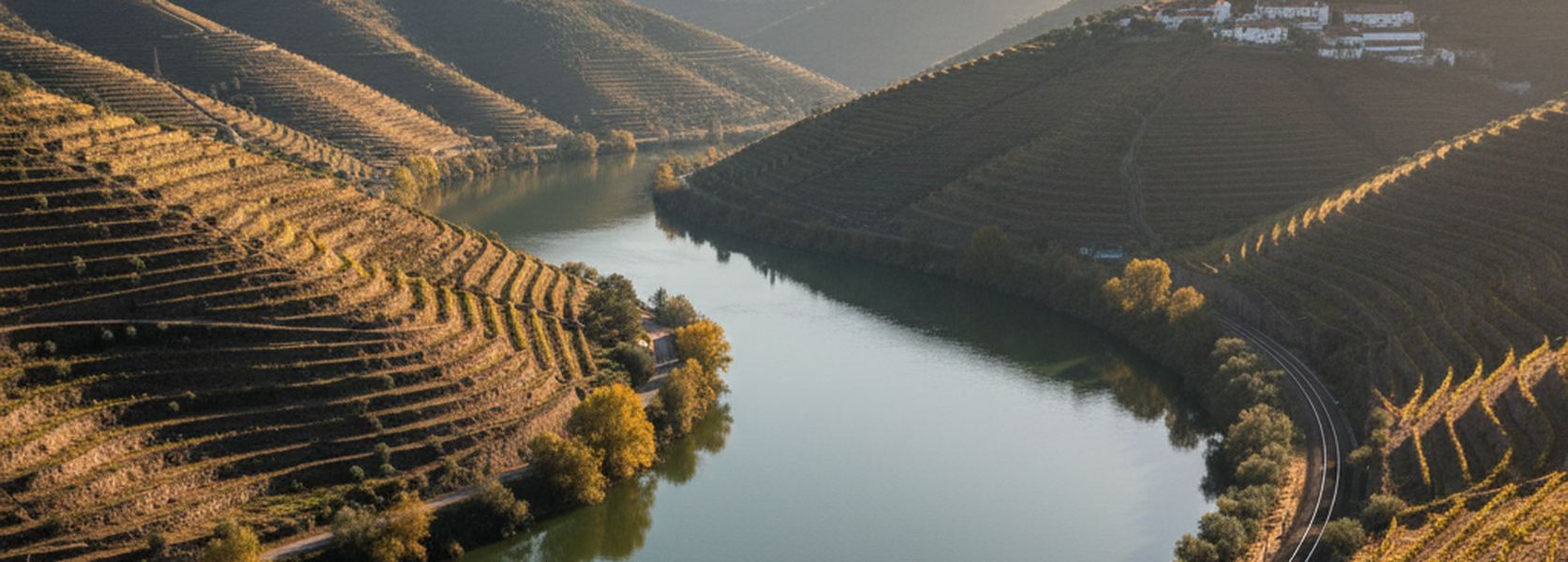
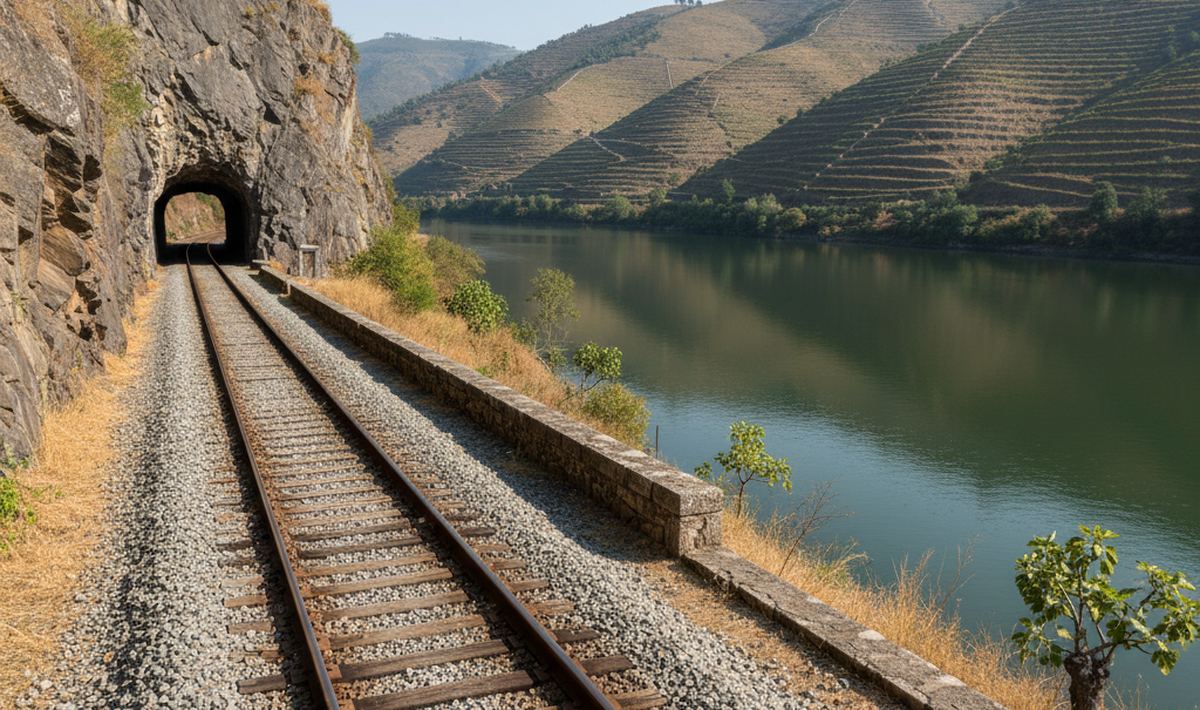
The Douro line runs about 170 km from Porto Campanha to Pocinho, and the slowest service takes three and a half hours. For the first ninety of those kilometers it has nothing to do with the river. It climbs inland through Penafiel and Marco de Canaveses, through cuttings and pine, and passengers who have heard about the view start wondering what the fuss was. The water arrives near Mosteiro, at eye level, and stays for the rest of the way.
Sit on the right hand side leaving Porto. The line crosses the river in the upper section, so the view changes windows; nobody minds if you get up and move.
There are no seat numbers and one class of carriage. Tickets are sold at the window and at the machines, roughly 14 euros for the full run and about 3 euros from Regua to Pinhao. Five or six departures a day reach Regua and three or four carry on. The timetable changes twice a year, so we check it in the fortnight before you travel, not in the month you ask.
What is left of this railway is a stump. Four branches closed between 1988 and 2009, at Pocinho, Tua, Regua and Livracao, and the last stretch of main line east of Pocinho went in 1988 as well. The rails now stop at a buffer, and the road carries on without them.
Three beds, nine nights
Nights one to three are in Porto, because that is where your own flight puts you, and because the first morning after a long journey is not the morning to be on a platform at seven. The station for the line is Campanha, twenty minutes on foot from the old streets or four minutes on a suburban train.
Nights four to six are at Pinhao, at the mouth of a side valley, where the river turns and the terraces stand up on both banks. From the platform it is 4.5 km and about 300 meters of climb to the village of Casal de Loivos, an hour and a half up and rather less down. Provesende and Favaios sit higher again and both need a taxi; the second of them makes a sweet white wine and says so at every doorway. Regua is 25 minutes back down the line, with a museum on the quay that sets out how the terraces were built and how the barrels used to move. Boat tickets are sold at the quay on the day. We do not reserve those.
Nights seven to nine are at Vila Nova de Foz Coa, 8 km and 200 meters above the railhead at Pocinho, which is why somebody meets the train. Then the same line back to Porto, three and a half hours, on the tenth morning.
The engravings at the far end
Along the lower Coa, in the last few kilometers before it reaches the Douro, there are figures cut into open outcrops of schist: horses, aurochs, ibex, a few fish. Some are pecked, some are scratched with a flint point in lines a millimeter deep. They were made roughly between 22,000 and 10,000 years ago. They were found in the early 1990s during work on a dam, the dam was stopped in 1995, and the valley became a park instead, which is not the way that argument usually ends.
You do not walk in on your own. Visits go by four wheel drive from three meeting points, eight people to a vehicle, an hour and a half to two hours on the ground, over loose schist and short steep slopes. Slots are limited and fill weeks ahead in April, May and October. Reserve yours as soon as the nights are fixed, or ask us to do it.
Take the late afternoon slot at the site where the light rakes across the rock. Many of the engravings are invisible at noon and readable at six; the rock is gray, the lines are gray, and only a low sun separates them. The museum on the promontory above the two rivers stays open when the sites are shut, which is what the middle of a hot day is for.
Heat, ground, and who this week is wrong for
The upper valley takes about 500 mm of rain a year against something near 1,200 mm on the coast, and nearly all of it falls between November and March. Summer is the problem. Afternoon highs at Pinhao and Pocinho sit between 34 and 40 degrees through July and August, the schist holds the heat and hands it back after dark, and there is no shade on a terrace path at all. April, May, early June and the back half of October run 18 to 25 with water in the river. Harvest is mid September to mid October and the days are still in the thirties. In December it is dark by half past five and the valley fills with fog, which is a thing to see once and not for nine nights.
The ground is loose schist and the villages stand 250 to 400 meters above the water. Several of the small halts have low platforms and high steps into the carriage, none of them has a lift, and one of the three beds is at the top of a cobbled lane.
This suits somebody who can spend forty minutes on a platform without minding, and who walks uphill for the pleasure of it. Wrong week for a traveler tied to a clock, for anyone who cannot get a case up four steps, and for anyone who means to cross a border by Thursday.
Short answers to the usual doubts
Can you reserve our seats on the trains?
No. The services on this line have one class of carriage and no seat numbers at all. You buy at the window or the machine and sit where there is room. A ticket bought eight weeks out gets you nothing that a ticket bought at 08:40 does not, so we will not sell you one, and nobody else can either. What we will do is tell you which departure out of Porto fills first on a Saturday, which one gives you the shaded side of the carriage in July, and which one leaves you at Tua for fifty minutes.
Do we need a car?
Not for the spine of the week. The line does the moving and the three beds are built around it. Above the river it is another matter: casal de Loivos is 4.5 km and 300 meters of climb from the Pinhao platform, Provesende and Favaios are further again, and Vila Nova de Foz Coa is 8 km up from Pocinho. Taxis work out of Regua, Pinhao and Pocinho, but there are not many of them, so the ones you need are arranged before you leave. If you want the 27 km of road between Regua and Pinhao, hire a car at Regua for one day and give it back that evening.
What is in the $2,380, and what is not?
Nine nights in three rooms for two sharing with breakfast, every rail ticket on the line for both of you, one guided visit to the engravings, and the two road transfers on the days a bed is not within walking distance of a platform. At roughly 14 euros a head for the full run and about 3 for the short hops, the rail comes to something near 40 dollars a head of that figure, which tells you where the money is and is not going. Not in it: your own flights, lunches and dinners, cellar visits, the boat, and anything with a steering wheel. The figure moves with the month and is confirmed before a single room is held. No card number reaches this desk at any point.
We were thinking August. Any reason not to?
One reason, and it is 40 degrees. Through July and August the afternoon at Pinhao and Pocinho runs 34 to 40, the terraces are stone and hand the day back at night, and the climb to a village at two in the afternoon stops being a walk. Nothing shuts, and people go anyway. If August is the fortnight you have, take the trains before ten and after six, keep the middle of the day indoors or on the water, and we will put you in rooms with shutters. If the month is open, say so and we will ask you the three questions again with a different one in mind.