Four telephone calls in Spanish are all we add when you book a farm week on the Aragon steppe
The honest answer first: the hard half of this needs a telephone call, and the easy half you could set up in one evening at your own table. What follows is a stone farm on the Aragon plateau, ten nights, one bed, from $2,260 per person, and what it means to book a farm week on the Aragon steppe when half of it needs no agent at all.
- Starting figure, per person
$2,260
- Nights
- 10
- beds you will learn
- 1
- Country
- Spain
- How much of this you could arrange without us
- the hard half needs a telephone call
Confirmed as a final figure once the supplier holds the dates. Getting to the country is not included.
- Whatever is agreed comes back to you in writing from the supplier, before any money moves.
- No card is asked for on this site and none is stored: the supplier takes payment on its own terms.
- A request sent through the form is answered in writing within one working day.
Underfoot, and what it does to a week
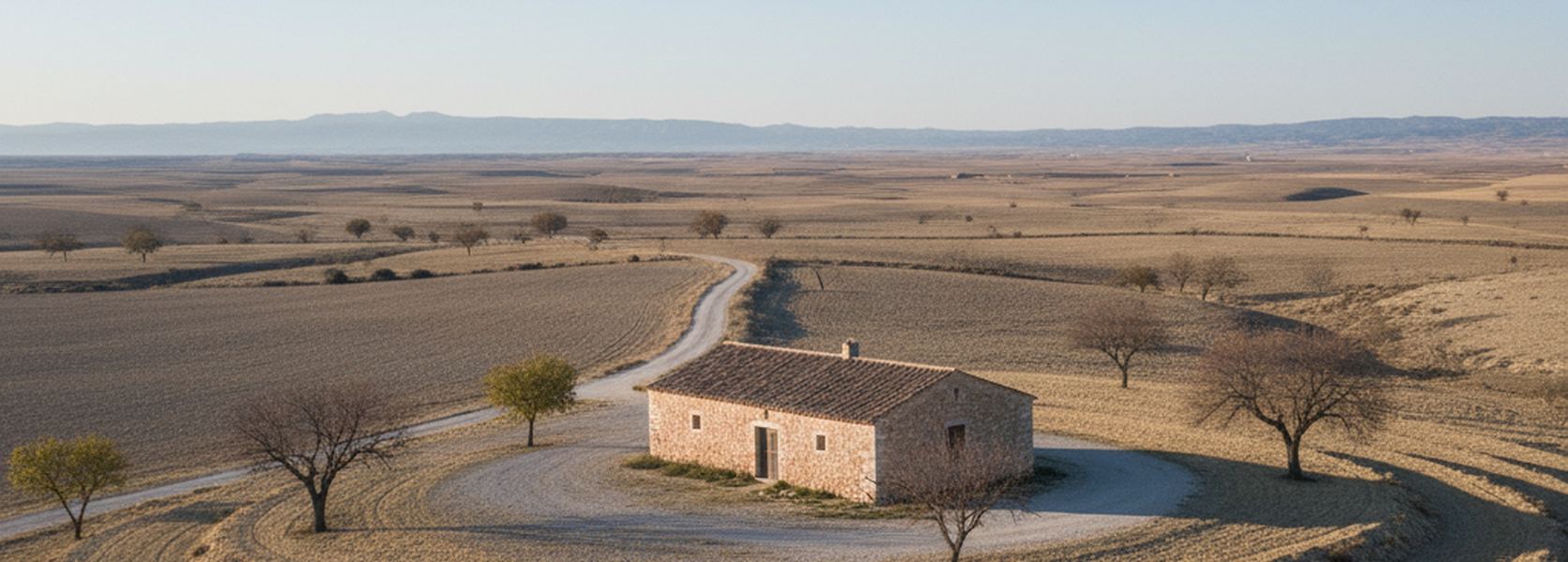
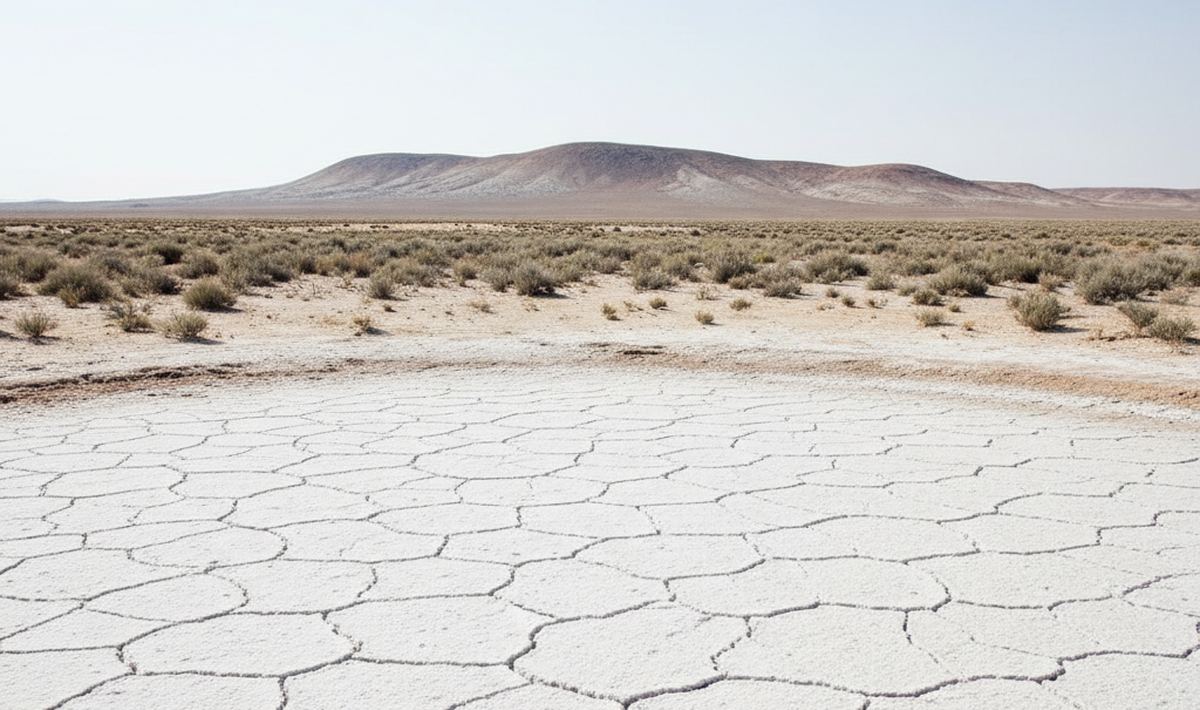
Los Monegros is a plateau of gypsum and limestone in the middle of the Ebro basin, spread across the provinces of Zaragoza and Huesca. It takes about 350 mm of rain a year. Kansas City takes roughly three times that. The result reads as flat from a car and is not: shallow dry valleys, called vales, cut between low tablelands, and the tablelands carry barley, almonds, and, where the irrigation canal reaches, sudden green rectangles of maize that have nothing to do with anything around them. Southwest of Bujaraloz there is a chain of closed basins, saladas, with no outlet at all. In March they hold a few centimetres of water the color of weak tea. By July they are white crust that crunches underfoot. Laguna de La Playa is the large one, roughly two kilometers across, and you can walk a stretch of its shore in an hour and meet nobody. Then there is the wind. The cierzo comes down the valley from the northwest, dry and cold, and it can hold 50 to 70 km/h for three days without pausing. It ends conversations outdoors and it rearranges your plans without asking. It also scours the sky, which is why the nights are what they are here, and why the far horizon carries turbines.
The house, and the ten nights in it
A single story stone farm building, what the region calls a torre, on its own track about 6 km from the nearest village. One bedroom, one bed. The reservation is the whole building, and the whole building is a kitchen, a sitting room with a wood stove, a bathroom, and a covered terrace facing east, because nobody here builds a terrace facing west into the cierzo. Water comes from a well and it is hard. The kettle furs within days, the shower is fine, your hair will have opinions. Heat is the stove and two radiators. There is a washing machine and no dryer, which in this air is not a problem: a shirt is dry in ninety minutes. The internet is a mobile signal and it wavers, so plan on a slow evening rather than a video call with people at home. Ten nights is deliberate and it is longer than most people first ask for. Two of them go to the drive out and the sleep afterwards. Somewhere around the fourth day the quiet stops being a feature you are noticing and becomes the ordinary condition of the day, which is when the week starts doing what it is for. Under about seven nights, most people spend the whole stay still braced.
Out early, indoors from two, the bar at nine
Nothing arrives to collect you and there is no schedule to fall behind. A day is coffee, then out early, before the heat in summer or into the fog in winter, then a long afternoon in which the village and most of the region is shut between two and five. Concrete things to fill ten days with. Walk the ridge of the Sierra de Alcubierre up to San Caprasio at 834 m, about three hours there and back from the col, with the whole basin laid out below and snow on the Pyrenean horizon into April. Read the restored trench line on the same ridge: george Orwell spent the winter and early spring of 1937 in that mud, and the parapets are still legible in the ground. Drive 40 minutes to a Saturday market town and buy the week in one go. Sit outside the bar in the village at nine in the evening, which is the hour the village actually exists. Sunset in late June falls around 21:30 and in late December around 17:35, and the shape of a day out here follows that far more closely than it follows your watch.
The half you can arrange alone, and the half we telephone for
Plainly, then. The house sits on public rental listings with a live calendar. The car is a counter at the airport. The shop, the Saturday market, the ridge walk and the trench line ask nothing of anybody: you could set the frame of this entire week up in one evening at your own kitchen table. If that is all you want from the ten nights, do exactly that. The price to you is identical either way, and we would be taking a commission from a supplier for typing an address. The other half does not answer email. The shepherd who will let two people walk out with the flock at half past six has a mobile number and picks it up between two and three in the afternoon. The olive cooperative presses for about six weeks from the middle of November and fixes its dates a fortnight ahead, on the weather. The key to the trench line lives in a village office open three mornings a week. The man who knows which tracks off the lagoons are passable after rain, and which ones are somebody's field, is not listed anywhere. Those four calls happen in Spanish, on landlines, inside Spanish office hours, seven hours ahead of Kansas City. That is the half this office is for.
What it costs, and who should not reserve it
From $2,260 per person covers the ten nights in the building, a small hire car from the airport at Zaragoza with the fuel on you, the first shop already in the fridge when you arrive, and three arranged days: the dawn walk with the flock, an afternoon at the press if you come in season, and a half day on the lagoons with someone who knows the tracks. It does not cover your flights, which are yours to buy and stay yours, your meals, or the deposit the owner holds against the building. The final figure is settled when the reservation is placed, because the house prices by season and the press only runs in autumn. This suits two people who drive, who read, who can be indoors from two until five without counting it as time lost, and who want ten days that are mostly their own. It does not suit anyone without a car. It does not suit the first three weeks of August, when afternoons sit at 36 to 38 C, which is 97 to 100 F, and a large outdoor music event fills the roads for one weekend. It does not suit a family, and there is no polite way around that: one bedroom, one bed, two people.
Short answers to the usual doubts
Do you reserve the flights?
No. Nothing that flies or floats is arranged from this desk, and we hold an agreement with no airline and no shipping line, so the flights are yours to buy, in your own name, on your own judgement. Tell us the arrival hour once you have it, because the first shop goes into the fridge before you land and somebody has to be told when. From the moment you have a car in Zaragoza, everything described on this page is ours.
Could we do this without a car?
Practically, no. There are a small number of regional trains a day on the Zaragoza to Lleida line and a village bus built around the hours of people going to work, and the house still sits about 6 km up a gravel track from the nearest stop. We have set a stay up that way twice, with the village shop delivering, and both times the ten nights contracted to one village, one bar and a lot of reading. If that is genuinely the week you want, say so and we will arrange it. Otherwise, drive.
When would you tell us to stay away?
The first three weeks of August, when the afternoon holds 36 to 38 C and there is no shade on the plateau that you did not bring with you. Late December and January, when the Ebro fog can settle for four or five days at a stretch and the ridge simply disappears; a few people come for exactly that and most do not. Weekends from October to February bring small game shooting, so expect vehicles on the tracks and gunshots from first light. March, April, late May, October and early November are the straightforward months.
What are we paying you for, if you take no money from us?
Nothing, directly. You settle with the owner of the house, with the hire desk, and with the two people who run the arranged days, each on their own terms, and none of it passes through Kansas City. We hold no card details and we do not want any. A percentage reaches us afterwards from their side of it, at a rate they set and we do not. So the useful question is not what our fee is; it is whether the four telephone calls described above are worth handing to somebody else. For a fair number of weeks in this catalog the honest answer is that they are not, and those pages say so on their own faces.